
Constructor X
March 11, 2026
Tasteful tree planting offers some of the best return on investment when you go to sell your property.
By QuinnCo Landscaping | Philadelphia & Surrounding Areas
There's something different about planting a tree. It isn't like laying sod or spreading mulch — those are seasonal investments. A tree is generational. A tree planted well this year will be providing shade, filtering air, and anchoring your landscape long after everything else in your yard has been replanted a dozen times over. A tree planted poorly will cost you more in removal fees than it ever would have in professional planting.
If you're searching for someone to plant trees on your property, you're already thinking bigger than most homeowners. This blog is for you — what professional tree planting actually involves, why it matters so much more than most people expect, and how to make sure the trees you invest in this year are still thriving thirty years from now.
Walk through any neighborhood — including most of ours here in Philadelphia — and you'll see trees that were planted too deep. The root flare, that widening at the base where the trunk meets the roots, is buried under three or four inches of soil or mulch. The tree looks fine in year one. It looks stressed in year three. By year seven it may be declining, and the homeowner has no idea why.
Planting depth is the single most critical factor in long-term tree health, and it's the one thing most homeowners get wrong when planting on their own. The root flare should always be at or slightly above grade. When it's buried, the tree can't breathe properly through its root system, bark begins to decay at the base, and the tree slowly strangles itself over years — sometimes decades — before you see visible symptoms.
A professional tree planting service gets this right from the start because they've seen what happens when it goes wrong. This single detail is worth the cost of hiring out.
Before any hole gets dug, the most important work happens in the planning phase — and it's where a professional landscaper adds enormous value.
Mature size matters more than current size. A tree that looks manageable as a 6-foot nursery specimen might have a 40-foot canopy and an aggressive root system at maturity. Planted too close to a foundation, a driveway, or utility lines, it becomes a liability. Planted in the right spot, it becomes an asset.
Sun exposure and soil conditions determine what will thrive. Philadelphia yards vary enormously. Some properties have deep, workable soil. Others — particularly older rowhouse lots — have fill soil, buried debris, or compacted urban clay that drains poorly and stresses many common tree varieties. Understanding what's in the ground before selecting a tree is the difference between a species that thrives and one that barely survives.
Native trees are almost always the right call. Trees native to the Pennsylvania and Delaware Valley region — species like Red Maple, White Oak, Eastern Redbud, Serviceberry, and American Hornbeam — are adapted to the local climate, support native wildlife and pollinators, and typically require far less intervention once established. At QuinnCo Landscaping, we lean native whenever the site allows for it.
Right tree, right place is a real phrase for a real reason. Overhead utility lines mean you need a low-canopy ornamental, not a shade tree. A wet low area in the yard is an opportunity for a water-tolerant species, not a death sentence for a tree that needs good drainage. These are the assessments a professional makes before planting — not after.
Tree planting done correctly is not simply digging a hole and dropping in a root ball. Here's what the full process looks like when it's done right.
We start by walking the planting site and assessing sun exposure, proximity to structures and utilities, soil composition, drainage patterns, and existing root competition from nearby trees. From there we discuss species options with the homeowner — balancing aesthetics, function (shade, screening, ornamental interest), mature size, and what the site can realistically support. We don't sell a tree first and assess later.
The planting hole should be wide — typically two to three times the diameter of the root ball — but only as deep as the root ball itself. This is the opposite of what most people intuit. Wide encourages lateral root expansion into loosened soil. Too deep buries the root flare. We measure before we dig.
Container and balled-and-burlapped trees both require preparation before going in the ground. Circling roots that have begun to wrap around the inside of a container must be corrected or they'll continue circling after planting, eventually girdling the trunk. Burlap and wire baskets must be removed or at minimum cut well away from the trunk and root zone. These steps take a few extra minutes and make an enormous difference over the life of the tree.
We backfill with the native soil from the hole — not amended soil or compost, which can create a subsurface environment so different from the surrounding soil that roots resist expanding beyond the planting hole. The tree is watered deeply during planting to collapse air pockets and begin root-to-soil contact. Depending on soil type and the time of year, a slow-release watering stake or ring may be installed.
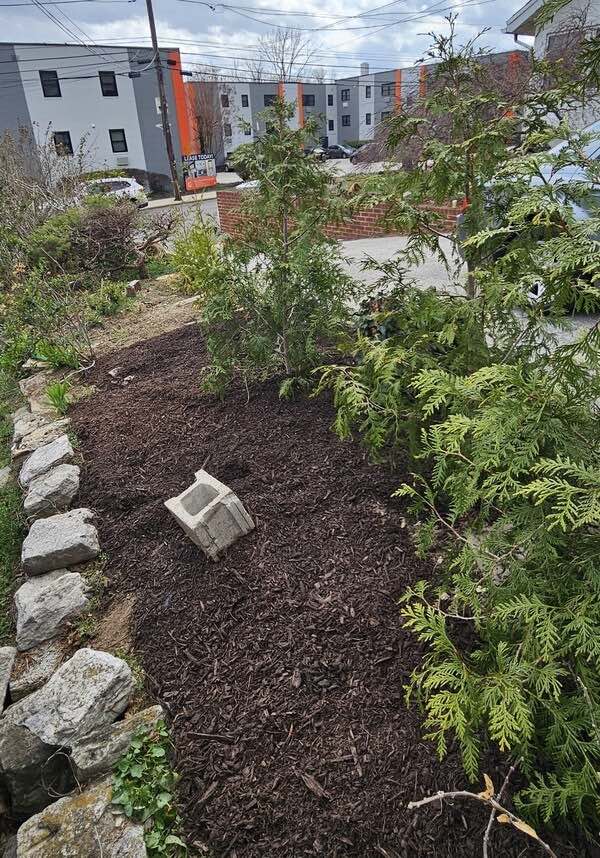
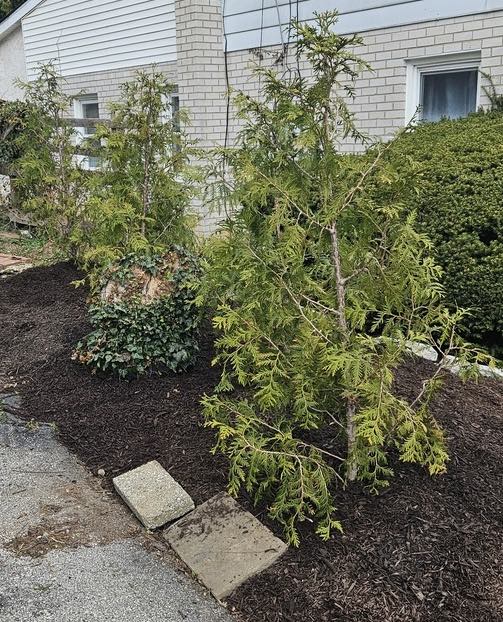
A 3-inch layer of wood chip mulch applied in a wide ring around the base of the tree — keeping mulch several inches away from the trunk itself — does more for a newly planted tree than almost any other single step. It retains soil moisture, regulates temperature at the root zone, suppresses competing grass and weeds, and gradually improves soil biology as it breaks down. What it should never do is form a "mulch volcano" piled against the trunk — one of the most common landscaping sights in any neighborhood and one that slowly damages the bark and invites decay.
Contrary to popular belief, most trees do not need to be staked after planting. A tree that can move slightly in the wind develops a stronger trunk and more robust root anchoring than one that's been rigidly staked for two years. We stake when site conditions genuinely require it — exposed locations with high wind, or unusually top-heavy specimens — and when we do, we use proper flexible ties and remove the stakes within one growing season.
Spring and fall are both excellent planting windows, for different reasons.
Fall planting — September through November in the Philadelphia area — is often the best choice for many species. Cooler air temperatures reduce transplant stress while soil temperatures are still warm enough to support root growth. A fall-planted tree gets a full season of root establishment before it's asked to support a canopy full of leaves the following summer.
Spring planting works well for most species and gives homeowners the satisfaction of watching new growth emerge in the first season. The risk is that a spring-planted tree immediately faces the demands of a full growing season — be prepared to water consistently through the first summer.
Summer planting is possible but requires vigilant watering and ideally some protection from full afternoon sun while the tree establishes. We generally advise against summer planting for large specimens when it can be avoided.
Bare-root planting — for certain deciduous species — is done in late winter and early spring while the tree is fully dormant. It requires timing and expertise but is often the most cost-effective way to establish certain species successfully.
This is a question worth sitting with before you call a landscaper. A single well-chosen tree in the right location does more for a property's character, value, and environmental impact than five trees planted in the wrong places. We'd rather help a homeowner plant one tree with intention than five trees that will create problems in ten years.
That said, some properties genuinely benefit from multiple trees — a screen planting along a property line, a canopy succession plan to replace aging trees before they come down, or a pollinator-focused landscape featuring a diversity of native species. These are conversations we love having with homeowners who are thinking about the long game.
If you need a practical reason beyond the sentimental one, here it is: mature trees add measurable value to residential properties. Studies consistently show that well-placed, healthy trees increase property values by anywhere from 7 to 19 percent. A large shade tree on the southwest corner of a house can reduce summer cooling costs significantly by shielding the building from afternoon sun. Street trees increase foot traffic and curb appeal in ways that affect how quickly homes sell and at what price.
The catch is that all of this is contingent on the trees being healthy and well-placed. A declining tree, a tree with a dangerous branch structure, or a tree planted too close to a foundation flips from asset to liability fast. Professional planting from the start protects the investment.
Urban and suburban planting in a place like Philadelphia comes with specific challenges that aren't always covered in general planting guides.
Soil compaction is nearly universal in older neighborhoods. Decades of foot traffic, construction, and vehicle pressure compact soil to the point where roots struggle to penetrate and water pools rather than draining. We assess compaction before planting and when necessary amend the planting zone in a way that improves drainage without creating a soil interface problem.
Overhead and underground utilities are everywhere. Before any planting, we call 811 and mark the site. We also factor mature canopy height into every recommendation — a 40-foot tree under a 30-foot power line is a future problem waiting to be created.
Heat island effects in dense urban areas mean some traditionally hardy species struggle in spots that would seem suitable on paper. We factor microclimate into species selection — a south-facing wall in a narrow row house yard creates very different conditions than the same address on an open lot.
If you've been thinking about adding trees to your property — whether it's a single focal point specimen, a shade tree for a sunny back yard, or a privacy screen along a property line — the best thing you can do is start the conversation before the season you want to plant in, not the week of.
Good tree planting takes planning. Species selection, sourcing quality nursery stock, scheduling, and site prep all take lead time. The homeowners who end up with the best results are the ones who called us in February about spring planting, or in August about fall planting, rather than two weeks before they wanted to see a tree in the ground.
QuinnCo Landscaping provides professional tree planting throughout Philadelphia and the surrounding area. We'll walk your property, talk through your goals, and help you choose and plant trees that will be standing strong long after everyone on the crew has retired.
Contact us for a free consultation and estimate. Plant something that lasts.
QuinnCo Landscaping — Rooted in craftsmanship. Serving Philadelphia, PA and surrounding areas.
Eu tincidunt tortor aliquam nulla facilisi. Aenean sed adipiscing diam donec adipiscing. Ut lectus arcu bibendum at varius vel pharetra.